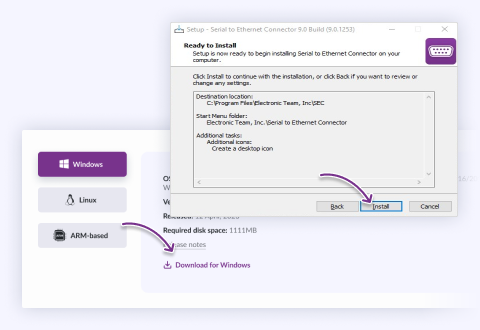
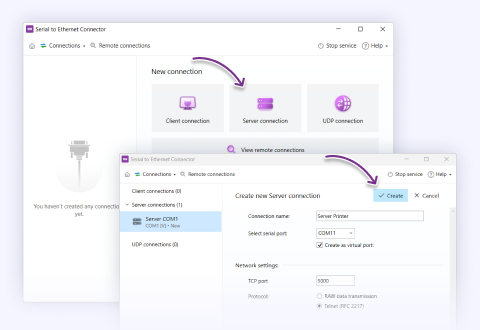
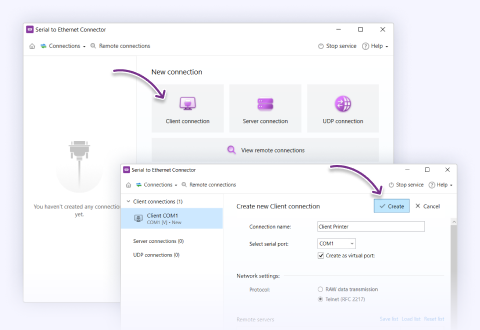
Yes — it's a first-class scenario, supported on Hyper-V, VMware, VirtualBox and XenDesktop. The key thing to understand is how: SEC does not hook the hypervisor's emulated UART. You install SEC on the host as a server connection, install SEC again
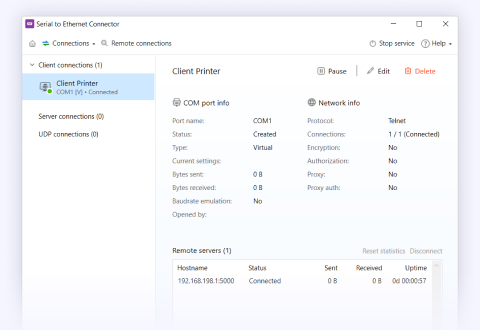
inside the guest, and the guest connects as a client over the virtual network. The guest then sees a virtual COM port that behaves like a local one, while the physical device stays on the host.
Because it works over the guest's virtual NIC, two things follow. The guest OS must be new enough to run current SEC (Windows 7 SP1 / Server 2008 R2 SP1 or newer, or a supported Linux), and the guest needs a working network route to the host. If your physical port is on the same machine and only one local VM needs it, the hypervisor's own built-in COM passthrough may be simpler and free — SEC earns its place when the device is on a different machine, several VMs need it, or you're on a VDI/broker stack that doesn't expose a host COM port at all.
Answered by Nikolai Svarachevsky · Lead Developer





What customers say