Cookie
Electronic Team, Inc. uses cookies to personalize your experience on our website. By continuing to use this site, you agree to our cookie policy. Click here to learn more.

Simultaneous Connectivity to Multiple COM Ports

Serial to Ethernet Connector supports sharing a serial port simultaneously with multiple clients. It also enables a single client to connect to multiple remote serial interfaces.
14-day Free Trial available
License price starts at $259.95
Available for

Transfer data from serial ports to multiple applications

Serial to Ethernet Connector lets you transmit data from a single serial port device to multiple remote computers. For example, you can connect a serially-connected GPS sensor to several remote computers and share its data simultaneously. Multiple users can access identical data at the same time with different applications from any network-connected location.
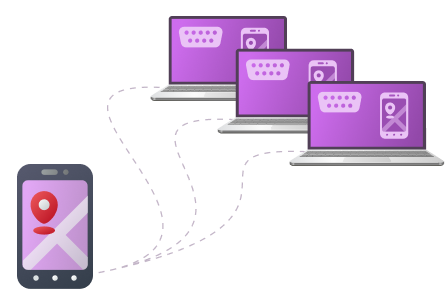
A GPS location being received by multiple computers

Consolidate data from multiple serial devices

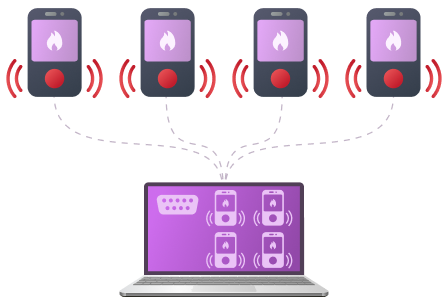
Serial to Ethernet Connector can consolidate data transmission from multiple serial devices to a single remote computer. For example, you can merge the data from several alarm sensors to a centralized computer. Now, an operator has access to the signals from all devices simultaneously and is better prepared to make informed decisions regarding the systems being protected by the alarms.
A system of sensors being monitored on a single laptop

How to share a serial port with multiple computers

1
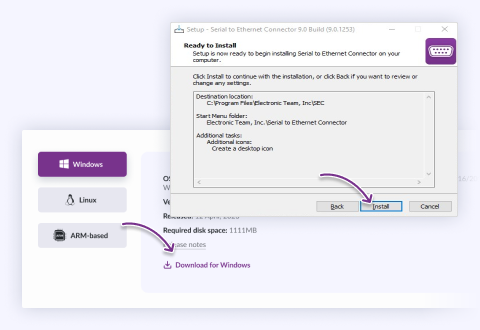
Install the Serial to Ethernet Connector on the computer with a physical connection to a serial device such as a GPS sensor. Install the software on all computers that need to access the GPS data.
Get the installer version for your operating system
2
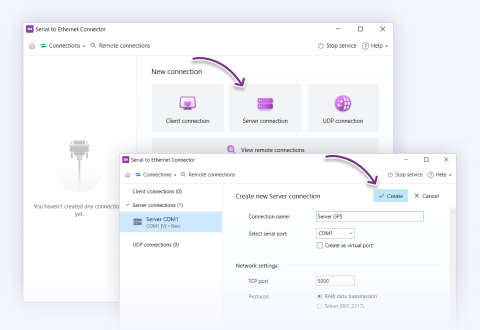
On the computer connected to the GPS, create a server connection that listens to the physical port.
Select Server connection on the host, and the RAW data protocol
3
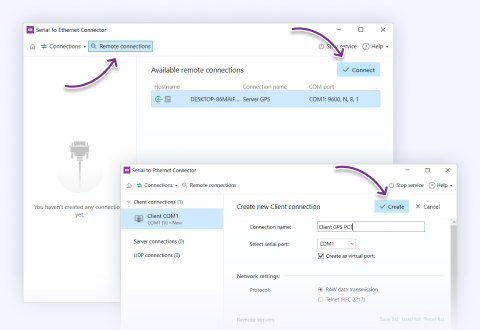
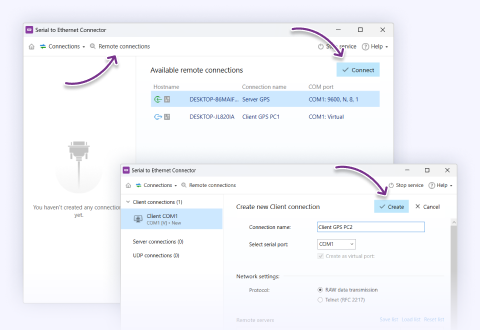
On a remote client machine, launch the software and navigate to the "Remote connections" tab. Select a name for the virtual port and click "Create" to establish communication with the server.
The tab is located on the toolbar at the top
4
Repeat the previous two steps on all computers that will access data from the GPS device.
Do the same thing on the single computer if you have multiple sensors
5
You can now transmit GPS data to all remote computers from a single server.
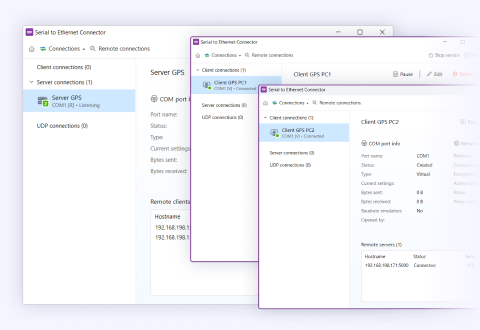
You can manage the connections either from the central computer or from the device hosts
Note: If automatic connection creation from the "Remote connections" tab is not functioning, you will need to create them manually. Please refer to the manual for instructions.

What customers say

4.9 overall rank, based on 372 users reviews
Successfully used by 150+ companies worldwide

Frequently Asked Questions

Yes — this is the classic fan-out, and it's exactly what a Raw server connection is for. The machine with the device runs one server connection on the port, and any number of client machines connect to it; each client receives a copy of the device's output. It's the natural fit for distributing a GPS feed, a sensor stream, or any device whose data several computers need at once.

Keep two things in mind. Use Raw mode for this — Telnet (RFC 2217) is peer-to-peer and won't accept multiple clients. And multi-client is safe for reading: if several clients also send commands to one command/response device, their writes interleave on the single physical port and corrupt each other, so arbitrate commands through one controlling client. Many readers, yes; many uncontrolled writers, no.

Answered by Nikolai Svarachevsky · Lead Developer
Yes. Because server and client connection types are interchangeable, the mirror image of "many clients, one server" is fully supported: one machine runs multiple client connections, each reaching out to a different server, and each mapped to its own virtual COM port locally. This is the standard fan-in — pulling several remote devices into one central computer.

The design rule that keeps it clean is one virtual port per remote source. Your application then reads each device on a separate, unambiguous port. Avoid the temptation to merge several remote servers into a single local port — their byte streams would interleave with no way to tell them apart unless the payloads are explicitly self-identifying. Separate ports, separate sources.

Answered by Nikolai Svarachevsky · Lead Developer
Yes, and it's more straightforward than it sounds. Each machine publishes its own real port as a server connection, then creates virtual ports that connect out to every other machine's server (all of them except itself). Do that on each node and every device's data becomes available on every other machine — that's your star. The interchangeable server/client model is what makes it compose cleanly, so there's no special "mesh mode" to hunt for; you just build it out of the same connections you already use.

The one thing to plan for is writes, not reads. Distributing each device's output to everyone works perfectly. But if several machines send commands toward the same device, those writes interleave on that one physical port — serial has no arbitration for multiple writers — so keep command traffic single-writer per device, or arbitrate it at the application level. If the layout gets large, one virtual port per remote source (rather than merging several into one) keeps each stream cleanly separated.

Answered by Nikolai Svarachevsky · Lead Developer
Because RFC 2217 hands one client authority over the port's parameters — baud rate, signal lines, port state — and that authority can't be coherently shared. If two clients were connected at once and each tried to set a different baud rate or drive RTS differently, the physical port would have no way to satisfy both. So the protocol is defined as peer-to-peer: exactly one client owns the RFC 2217 session at a time.

This is why multi-client sharing uses Raw mode, which carries no port-parameter ownership and can therefore duplicate a byte stream to many clients safely. The two modes are complementary by design: Telnet/RFC 2217 for a single peer that needs full port control, Raw for many peers that just need the data. If you need both control and fan-out, give the controlling consumer its own dedicated Telnet connection separate from the Raw fan-out.

Answered by Nikolai Svarachevsky · Lead Developer
Yes. In a raw-mode server connection, the Data transfer settings give you a Send data to dropdown, and one of its options is Last active — data is sent only to the client that responded last. That's exactly the "reply only to the last connection that wrote" behavior; you're not stuck broadcasting the device's output to every client. There's a matching Receive data from dropdown with the same choices (None, Only first / Only last, Last active, All), so you can control the inbound side too.

The default for both is All — every client receives the device's output — which is the right setting for a device that simply streams to many readers. When you have a request/response device shared among several clients and want each answer to return only to the requester, switch Send data to to Last active. Two things to keep in mind: this is a raw-mode feature (in Telnet/RFC 2217 the connection is one-to-one anyway), and if several clients can write in quick succession, coordinate them at the application level so "last active" resolves to the client you actually mean.

Answered by Bohdan Miniv · QA Engineering
Serial to Ethernet Connector
Connect Multiple COM ports at a time
14-day Free Trial available
License price starts at $259.95
Available for