Cookie
Electronic Team, Inc. uses cookies to personalize your experience on our website. By continuing to use this site, you agree to our cookie policy. Click here to learn more.

Redirect Serial Port Data over Telnet

Serial to Ethernet Connector enables you to use the Telnet RFC 2217 protocol to access serial devices.
14-day Free Trial available
License price starts at $259.95
Available for

Access serial ports via Telnet RFC 2217

Serial to Ethernet Connector provides remotely accessing serial devices such as industrial monitoring equipment that supports the Telnet protocol. Telnet allows you to connect to remote serial ports as if they were local to your machine and maintain all functionality over connected devices. Using Telnet gives you the ability to work with devices that employ signal lines to transmit additional data such as baud rate, parity, and stop bits. Examples of this type of device include modems and printers that use the Data Carrier Detect (DCD) signal to indicate they are ready for operation.
A piece of serial hardware being shared between two computers

Consider these network settings when working with Serial to Ethernet Connector:

The Raw protocol ignores all parameters and transmits data directly from the serial port to the network. When using this mode, you need to configure the physical port correctly to ensure proper functionality. You can establish multi-connections using this protocol.
Telnet with RFC 2217 extensions enables the server and client to exchange Telnet IP port information. Changes to the local port are communicated to the remote machine, eliminating any worry about coordinating the settings. This mode only allows peer-to-peer connections.

How to redirect Serial port data over Telnet

1
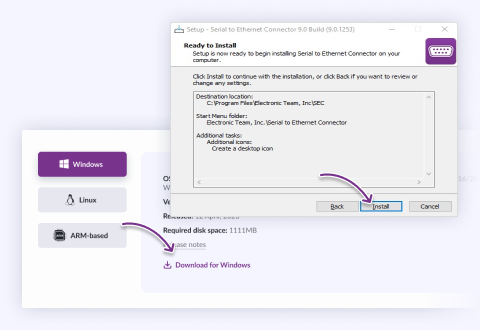
Install the Serial to Ethernet Connector software on the computer with a connection to the serial port device and the remote machine that will access its data.
Get and launch the installer
2
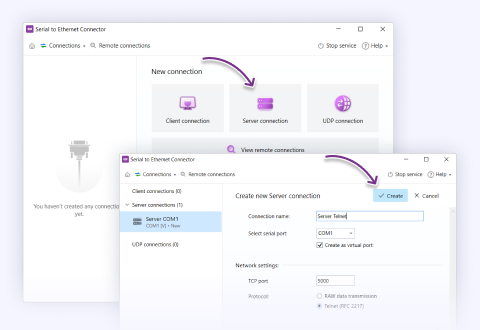
Set up a TSP server connection on the computer connected to the device.
Make sure to select “Telnet” on the host computer when creating the connection
3
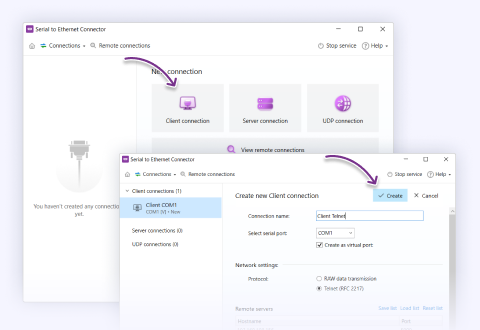
Go to the “Remote connections" tab on the second machine and click on the previously created server to establish a connection. Select a name for the virtual port and click “Create” to complete the connection.
Select “Client connection” to find the shared device
4
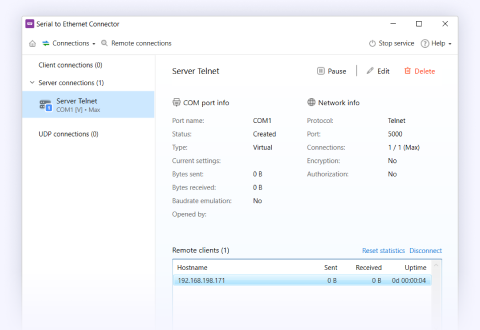
You can now access the serial device over Telnet with the same level of control as with a direct physical connection.
You can edit a connection and view info on it on either device

What customers say

4.9 overall rank, based on 372 users reviews
Successfully used by 150+ companies worldwide

Frequently Asked Questions

Choose Telnet (RFC 2217) when the remote application needs to control or track the port itself — set baud rate, parity, data/stop bits, toggle or read RTS/DTR/DCD, send BREAK. RFC 2217 carries all of that across the link so the two ends stay in sync automatically, with no manual coordination. The cost is that it's peer-to-peer: one client per shared port.

Choose Raw when you just need to move a byte stream and the port settings are fixed or the application doesn't touch them. Raw ignores port parameters — so you configure the physical port's baud/parity yourself on the host — but it allows multiple simultaneous connections, which Telnet mode doesn't. Quick rule: device needs remote configuration or signal control → Telnet; simple fixed-rate stream, or you need to fan out to several clients → Raw.

Answered by Nikolai Svarachevsky · Lead Developer
In principle yes — RFC 2217 is a published standard, so SEC can interoperate with compliant third-party implementations, including hardware console/terminal servers from vendors like Digi, Lantronix and Moxa that expose the Telnet COM-port-control option, and with software endpoints such as a Linux ser2net/pySerial server. That interoperability is one of the reasons to prefer Telnet mode when you're bridging to non-SEC gear.

The honest qualifier: always bench-test the specific pairing before you rely on it. Implementations differ in which optional RFC 2217 commands they support and how strictly they follow the spec, so a given hardware server might handle baud-rate negotiation but not some signal-line command, or vice versa. It usually works — but "it's a standard" is not a substitute for confirming your two particular devices agree in practice.

Answered by Bohdan Miniv · QA Engineering
The flow-control signals are represented: RFC 2217 carries the control-line state (RTS/CTS and the flow-control mode) between the ends, so hardware handshaking is understood by the protocol rather than ignored the way it is in Raw mode. For setup and for devices where flow control is about correct configuration, this works.

The limitation is responsiveness over a network. Hardware flow control exists to throttle a fast sender the instant a receiver's buffer fills — a real-time reaction measured in character times. Across a network link, the CTS change has to travel back over TCP with its latency and buffering, so it may not arrive fast enough to stop an overrun on a high-throughput stream. On a low-latency LAN it's usually fine; over the internet, don't rely on remote hardware flow control to prevent buffer overruns on a fast device. Where possible, let flow control act locally at the physical port and carry only the data over the link.

Answered by Nikolai Svarachevsky · Lead Developer
Because RFC 2217 negotiates and owns the port's parameters for a single session. The whole point of Telnet mode is that one connected client can set the baud rate, flip signal lines and read port state — and there's no coherent way for two clients to each hold that authority over one physical port at the same time. If two clients requested different baud rates, whose wins? The protocol has no answer, so the mode is defined as peer-to-peer.

That's exactly why Raw mode exists for the one-to-many case: Raw carries no port-parameter ownership, just bytes, so it can safely duplicate the stream to many clients. The trade-off is the flip side of the same coin — Raw gives you multiple clients but no remote port control; Telnet gives you full port control but a single peer. Pick the mode that matches whether you need control or fan-out.

Answered by Nikolai Svarachevsky · Lead Developer
Because RFC 2217 is defined as an option on top of Telnet, which runs over TCP — and it depends on exactly the guarantees TCP provides. The port-control commands (set baud, set signal lines) are negotiated in-band and rely on the stream arriving reliably, in order, with the two ends able to acknowledge each other. That's a connection-oriented conversation.

UDP offers none of that: no connection, no ordering, no delivery guarantee, no acknowledgement. A negotiation that assumes reliable ordered delivery simply can't run over a transport that can drop or reorder the very command that sets the baud rate. So the two modes split cleanly by transport: RFC 2217 signaling belongs on TCP, and UDP is for raw one-way data only. If you need signal/parameter control, you're on TCP by necessity.

Answered by Nikolai Svarachevsky · Lead Developer

Yes — this works in Telnet mode just as in Raw. SEC's packetization controls include a "send when a character with a given code is received" option, so you set it to your message delimiter and SEC holds incoming bytes until that character arrives, then forwards the accumulated message as a unit. That keeps your frames intact across a network that would otherwise fragment or coalesce the byte stream.

It pairs with the related triggers — hold for a set time, or flush when a block reaches a chosen size — and the usual trade-off applies: waiting for the delimiter deliberately adds a little latency in exchange for clean framing. For a line-oriented protocol (messages ending in CR/LF) it's exactly the right setting; for a device that needs the lowest possible latency on every byte, leave it off.

Answered by Nikolai Svarachevsky · Lead Developer
Serial to Ethernet Connector
Redirect COM port to Telnet
14-day Free Trial available
License price starts at $259.95
Available for