Cookie
Electronic Team, Inc. uses cookies to personalize your experience on our website. By continuing to use this site, you agree to our cookie policy. Click here to learn more.

Transfer Serial Data to the Cloud

Installing Serial to Ethernet Connector on a cloud server gives it access to network-connected local serial ports.
14-day Free Trial available
License price starts at $259.95
Available for

Establish cloud access for COM port devices

Serial to Ethernet Connector supports communication between cloud computers and virtually any type of serial port device or peripheral equipment. Cloud computers running application software can access and control serial devices with the same functionality as achieved with a direct connection to the COM port or device.
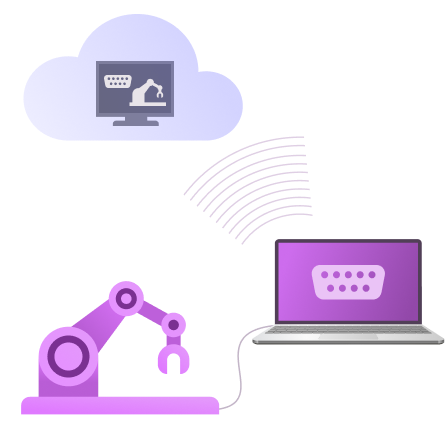
Serial hardware being connected to a cloud server

Supported cloud environments

Serial to Ethernet Connector supports redirecting serial port devices in multiple cloud environments including Azure, AWS, VMware ESX, Oracle, UIBM Cloud, and Google Cloud.
Popular cloud service providers

How to establish cloud access to a serial port device

1
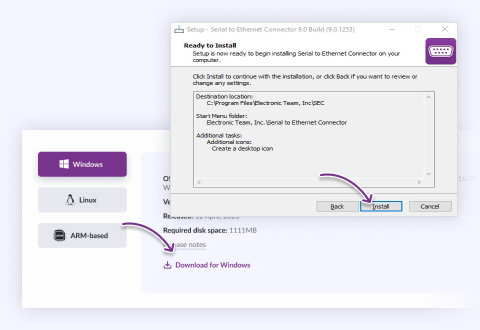
Obtain cloud service that provides a public IP address. Install Serial to Ethernet Connector on a local and cloud computer.
Select your system, get the installer and run it
2
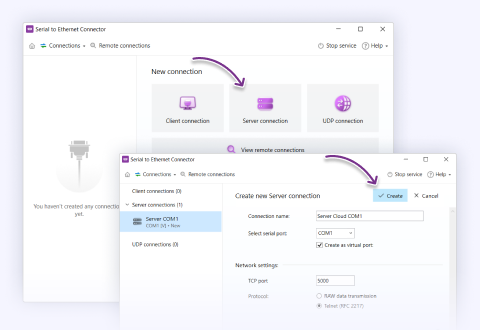
Create a virtual port on the cloud computer with a connection type of server and Telnet for data transmission type.
Set up a “Server connection” on the computer that hosts the device
3
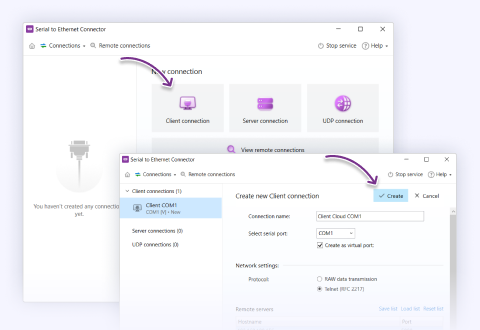
Configure the physical serial port on the local computer with the connection type client. Use the cloud’s real IP address and the TCP port number for the connection address.
Start a “Client connection” on the cloud server
4
You can now access the serial port device from the cloud machine.
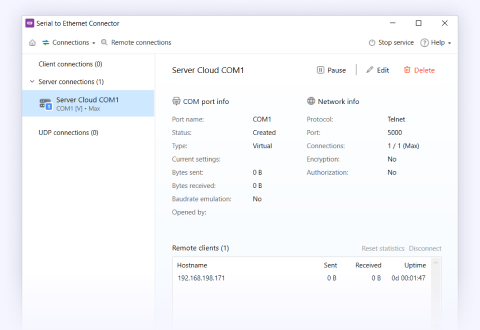
Select the connection from the list to get information about it

What customers say

4.9 overall rank, based on 372 users reviews
Successfully used by 150+ companies worldwide

Frequently Asked Questions

The essential ingredient is a reachable address on the cloud side — a public (ideally static) IP, or a hostname that resolves to one — plus the chosen TCP port opened inbound in the cloud firewall / security group. Install SEC on both ends: the cloud machine runs a server connection with a virtual port that your cloud application opens, and the local machine holding the physical device runs a client connection that dials out to the cloud's public address.

Having the device side dial outbound to the cloud is the recommended topology: the machine physically attached to your hardware then needs no open inbound port, only outbound access. Because this link crosses the public internet, enable SEC's authentication and encryption, and — where you can — restrict the cloud security group to the device site's egress IP rather than leaving it open to the world.

Answered by Nikolai Svarachevsky · Lead Developer
Yes, but with a real caveat you need to design around. A physical COM port is exclusive-open — one process at a time — so a local application and the cloud can't both hold the same real port directly. The workable pattern is a virtual-port pair on the local machine: the local app talks to a virtual port, SEC bridges it to the real port, and the cloud connection shares that same bridged data.

The honest warning: once both a local app and a cloud app are attached to one device, their traffic can mix. Inbound data from the device fans to both consumers (fine for read-only), but if both sides send commands, those commands interleave on the single physical UART and corrupt each other. So "local and cloud at once" is safe for shared reading; for commanding the device, make sure only one side writes at a time.

Answered by Nikolai Svarachevsky · Lead Developer
Yes — this is a fan-in topology and it works well. On the cloud machine you create one virtual COM port per source, each fed by a client connection dialing in from its respective site (or by servers at each site that the cloud connects out to — the connection types are interchangeable). Your cloud application then sees a separate, clean COM port for each remote device.

The design rule that keeps this sane: give each source its own virtual port rather than merging several devices into one port. If you funnel multiple devices into a single port, their bytes arrive interleaved with no way to tell which came from which. One port per remote device — and remember each site's link carries its own internet latency, so size timeouts per source, not on a single assumption.

Answered by Nikolai Svarachevsky · Lead Developer
Throughput is almost never affected in any way you'd notice, because serial data rates are minuscule compared with network bandwidth — even a fast serial link is a trickle next to a normal internet connection, so SEC isn't bandwidth-bound. What SEC and the network add is latency, not a throughput ceiling: a small software overhead plus the round-trip time of the path to the cloud.

For continuous or bulk transfer that latency is a one-time pipeline delay and effective throughput stays high. Where it shows up is chatty request/response traffic, where every exchange pays the round-trip and the effective rate drops even though raw bandwidth is ample. If that's your pattern over a long cloud path, reduce the number of round-trips (batch requests, keep a poller local to the device) rather than expecting SEC to speed up the link.

Answered by Bohdan Miniv · QA Engineering
The signal-line state is carried when you use Telnet (RFC 2217) mode: the remote application's RTS/DTR changes are transmitted and applied at the physical port, and line states like CTS/DSR/DCD are reported back. In Raw mode none of this is carried — Raw moves data only. So for signal control, use Telnet mode.

The honest limit is timing, not capability. RFC 2217 carries control-line changes in-band and loosely synchronized with the data stream, so over a cloud link with buffering and internet latency, the exact moment a line changes relative to the data is not deterministic. For status signals and setup that's fine. For real-time uses — software-driven half-duplex RS-485 direction switching, or precisely-timed BREAK — don't drive the line remotely over the internet; handle that timing locally at the device and use the cloud link only for data.

Answered by Nikolai Svarachevsky · Lead Developer
Yes. In Raw mode SEC has a Signal Lines tab where you can configure which signal lines are raised or lowered on connection — so you can have a line asserted when a network client attaches and dropped when it disconnects. That's exactly the "a remote client is now attached" indicator you're describing, and it's a supported setting rather than something you have to improvise.

Worth understanding the distinction from Telnet mode: there, SEC reflects the actual hardware line states between the two ends, so the lines follow the device rather than the connection. The configurable connect/disconnect line behavior is the Raw-mode feature. Set the specific lines and their on-connect / on-disconnect states in that tab; if your target line or polarity isn't among the options, describe the exact goal to support and we'll confirm what the current build allows.

Answered by Bohdan Miniv · QA Engineering
SEC has a keep-alive setting that handles exactly this. It periodically checks that the link is still live, so a connection that has silently dropped is detected and torn down rather than sitting there looking alive. By adjusting the keep-alive timing you control how closely SEC watches the link — shorter intervals detect a drop faster, longer ones are more relaxed.

The reason this matters is that a silently dropped network path — a "half-open" TCP connection where one side vanished without a proper close — can otherwise appear connected until something actually tries to send data. The keep-alive check is what surfaces that quickly and lets the connection re-establish cleanly. Tune the timing to your needs: tight enough to catch a real drop promptly, loose enough that a naturally quiet device isn't flagged during normal idle periods.

Answered by Bohdan Miniv · QA Engineering
Work through these three in order, because they cover the large majority of "won't connect" cases. First, confirm the IP address of the remote host is set correctly on the client connection. Second, make sure the TCP port you chose isn't being blocked by a firewall — on the server machine, on the client, or anywhere on the network path between them. Third, confirm that both local COM ports are open — the real or virtual port on each end has to be available and not held exclusively by another application.

If all three check out and it still won't connect, the usual next culprits are a security group / NAT rule on a cloud or cross-site link, or a port already in use. The connection status in the SEC interface will tell you which side is failing to come up, which is the fastest way to narrow it down.

Answered by Bohdan Miniv · QA Engineering
Serial to Ethernet Connector
Passthrough your serial port to the Cloud
14-day Free Trial available
License price starts at $259.95
Available for